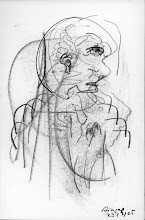
Steiner writes: 'I believe the matter of music to be central to that of the meanings of man, of man's access to, or abstention from, metaphysical experience.' p 6
For me, this is another golden sentence. When I arrived in Oxford in 1995, leaving behind job, country and friends of 15 years, husband etc. it was shock to be back in grey UK. I fell below the word line, could hardly write at all, don't know how I managed at work. Music and drawing saved me. I listened to music almost non-stop - it was like a desperation, a soul need, and it worked.
Pictures sit there silent and timeless, keeping their secrets, but music reaches out and touches you, even when you can't move, I think.
Monday, 26 November 2007


Thursday, 22 November 2007
Magic memory - re the piece below.
Now theeeeeeere's a thing.... A term that I and a few painters I know use - but most 'know' it intuitively because it is what we all draw on all the time - in our minds eye - those times - those places - that person.
I'm not sure where the term came from -perhaps the S.American magic realists. When you do stuff from memory -you trust it as best you can -you 'hold' it - you believe it - like a bucket to the well.
It is coloured in all sorts of subconcious ways - it is magic memory - it is a distillation of your very particular experience and experiences - no one has the same magic memory of the same thing - but others will recognise your version - because the seeds are the same. Magic memory is also like a doodle - a thing to use. A thing to also encourage and practise in yourself when looking - check the big spaces, the main colour blocks, odd bits of informational detail - whatever you want - but as long as you conciously look and see, even say to yourself - 'I'll remember this' if you want - you've committed it to magic memory somewhere. When working from such memory, you have to be as bold and intuitive as you can - then more will come.
I'm not sure where the term came from -perhaps the S.American magic realists. When you do stuff from memory -you trust it as best you can -you 'hold' it - you believe it - like a bucket to the well.
It is coloured in all sorts of subconcious ways - it is magic memory - it is a distillation of your very particular experience and experiences - no one has the same magic memory of the same thing - but others will recognise your version - because the seeds are the same. Magic memory is also like a doodle - a thing to use. A thing to also encourage and practise in yourself when looking - check the big spaces, the main colour blocks, odd bits of informational detail - whatever you want - but as long as you conciously look and see, even say to yourself - 'I'll remember this' if you want - you've committed it to magic memory somewhere. When working from such memory, you have to be as bold and intuitive as you can - then more will come.
Steiner - Drawings - Itsuki - Flatholm
Heyla Anj,
The disc with 7'retro' digital drawings taken from scribbles and photos taken on Flatholm have finally gone to the printers today, it's a load off - he'll give me a price for framing and mounting them at A2 ish. Now its down to the free painting to do with Marconi - so all in all - at least I'll have something to show.. we hang on the 8th & 9th Dec - opens on the 10th & Rhodri Morgan is officially opening it on the 17th Dec.
The Steiner is still as oddly dense as I remember it to be - but like the quote you put up - it has many many little flashes of sentences here and there that strike a loud chord - and are usefull.
It is an odd book in many ways and a brave one - he has to admit freely that he; like much journalese and his own world of academic thesis and commentary that he has a critical eye on in various passages - is doing the same thing: Providing yet more commentary on the creative process - which is primal and needs no angel to sanctify it let alone a professor.
He tries to do much much more though - and I think he succeeds - because, even though an academic of the deepest learning - and partly because of his history and his families history - he brings a deeper voice to his thinking that has a quiet empathy within it - because he damn well cares - and so is not prepared to be soft or to flinch from any common or elevated truths that work for him as well as possibly against him - he picks his way thru this stuff - always giving examples - which can be very enlightening.
This has been important to me Anj, particulary later when he talks about the possible 'meaning of meaning' ( although that goes thru it all the way) and cuts a huge swath thru post modern posturing to arrive at a position of tranquility ? - that must always include the reality of communication - as a fundimental and emotive thing - not an academic exercise.
That's why after I read it - not understanding half of it - but understanding very well the things in it that spoke to me - but with pieces jumping out at me - I kept using it as a 'dippin in' book and slowly more bits of it joined up.... and are still doing so.
The book helps - mindset - and being an artist is about mindset and 'will' rather than pure technique.
I mention the Itsuki background in Angie2 - so I won't go into that here....I don't want it to get mixed up out of context.
I also talk about drawing there - but I would say that I like the drawings very much and I might cover some ground from Angie2, but that's ok in this case.
The drawing that you put up as a 'logo' for the blog - I've only glanced at -ever- because one look and I said to myself ' Oh, Ok - good choice Anj - from the later Picasso etchings to do with the artist as monkey -or maybe from the Bachus stuff or the Minatour stuff - anyway - nice classic Picasso drawing.'
Now I see and from yr writing that it's yours.
I look from some odd 'classical' viewpoint y'see, that I can't define - I expect the best - and I find that I am hardly ever dissapointed, ( at least not by the work in all its prime innocence or strategies) I'm always only surprised that others can't see it. ie I had no internal reasons to think oh it's 'just'a scribble by so and so - like a lot of the stuff on the paintersonline site, it's all good in some way, but as Steiners book lays out - difficult to talk about directly - or at least in the way one wants to talk of these things.
I've been shown many blobs and swirls and Dalieque meanderings and death metal pain and angst paintings and sexual vanity paintings and sci fi paintings by people I've known over the years - and to use a very old fashioned phrase - 'they are scoundrels' - and I know that anything I say will go directly to that part of their ego. Still: y'look at the work and you speak as y'find - and it is of absolutely no help to them at all in the end - they don't have the mindset - they don't know how to carry things onward -they don't want or invite or embrace the real wonder of it all. It's always. ' Do y'think I could sell it?' 'do you think I could get into art college'
(not a hope in hell - but today, possibly yes!) - ' Do you really really think it's like Van Gogh?' - Bah!
I love that little drawing - and would do a swap for it sometime - IF y want to - if y'still have it.
( It's the only one I can't click on to make bigger!)
All the other drawings - again I cover something of this in Angie2 - about a week away, but what might help you straight off - particulary if you want to try those 3 portraits, Joss, Keith & Jay again a few times and in a few different ways.
Everything occupies space - in music it is layered - in looking with our eyes, it is layered - both have depth. Lets say the sheet of white paper is the whole orchestra and the thing you want to draw is the score. ie it embodies the real thing -the real presence -and again - as Steiner remarks - ALL is interpretation of SOMETHING.
I like the look of the drawings and their scribbly bits and the rubbed out outlines providing hesitant halo's, the tentative curving lines near the edges that try and provide a way for the eye to see them as curved receeding or advancing space, the hesitant highlights.
Here's something to try.
Lets say the first space or sound we'll put down is the major mass, the first uniting chord - rub some pencil lead on with a bit of soft cloth, but not too dark - perhaps it forms half or more of the face and neck and shoulders ( if any) so you have a floating light grey shape - you can try it at a few different densities on paper - ie do a few at a time on A5 - say 3: three shapes for 3 different Joss's, Jay's and keiths - let them differ - let one side of some of the grey mass be darker in some. The second space is definition of the space itself - you arn't drawing closely around the grey soft shape - it has to have space inside the outer defining line ( because that's where some light comes through) Draw that line clearly from whichever direction you want, all at once or in bits - crown, ear, cheek, chin and up the other side, if it doesn't join up -leave it be.
When I say draw directly and cleanly, it doesn't have to be all in one uninterrupted line - the quality of markmaking is up to you. Directly and cleanly draw the neck lines and the shape of a collar or scarf as it lies and falls onto the chest or shoulder. Look at the shapes first from your previous drawing and how the larger mass of the shapes fit together.
We have a soft shape inside, or surrounded by, strong lines. Work into these main shapes with other shapes and marks as if an instrument, a chello here, some pizzicato violins there, but don't crowd it all at onece - check back and fore for the real shapes of the score, the particular accents of sound and shape that speak of the particular person - if its from 'magic memory' or a photograph, choose what pleases you and fits best with what is infront of you so that it helps make a whole sound. Some bits may be out of sync in their sizing, don't worry, let the orchestra carry it, and leave it alone. Once I've played a note, it is gone in time, I can't unplay it, but can listen/look back later and see the whole relationship that it sits within - perception changes.
Add balance and little mark riffs as you think and feel them -the little trills, the decor, but make them clear. ie they may have different stroke weights n strengths, but they are all IN the orchestra and no instrument hides - just give them their voice no matter how small or fast or slow you make the mark. I said to try about 3 of each because experimenting with line weight and density of marks as they balance in a finished work that shouldn't take too long is a way to move quickly and not get bored.
Balance - a load of sqiggles on one side is not neccecerilly balanced by the same on the other, a density of white space can do it or a couple of fullsome marks. ie Blance doesn't equate with symmetry.
Like colour - you need an awfull lot of yellow to balance a small patch of red
I'm going to leave that there Anj - these are drawing exercises about ways to move forward not in how to render things - you do that fine on your own - I'm perhaps trying to clarify the sound here and there or suggest a different way of listening.
Cheers for now -alla glory - Dai
( Haven't had time to spell check - Sam is dying to get on this computer to get some homework done - see y'later)
( Have since come back and re-edited the last bits of the drawing stuff to make it clearer - I hope)
The disc with 7'retro' digital drawings taken from scribbles and photos taken on Flatholm have finally gone to the printers today, it's a load off - he'll give me a price for framing and mounting them at A2 ish. Now its down to the free painting to do with Marconi - so all in all - at least I'll have something to show.. we hang on the 8th & 9th Dec - opens on the 10th & Rhodri Morgan is officially opening it on the 17th Dec.
The Steiner is still as oddly dense as I remember it to be - but like the quote you put up - it has many many little flashes of sentences here and there that strike a loud chord - and are usefull.
It is an odd book in many ways and a brave one - he has to admit freely that he; like much journalese and his own world of academic thesis and commentary that he has a critical eye on in various passages - is doing the same thing: Providing yet more commentary on the creative process - which is primal and needs no angel to sanctify it let alone a professor.
He tries to do much much more though - and I think he succeeds - because, even though an academic of the deepest learning - and partly because of his history and his families history - he brings a deeper voice to his thinking that has a quiet empathy within it - because he damn well cares - and so is not prepared to be soft or to flinch from any common or elevated truths that work for him as well as possibly against him - he picks his way thru this stuff - always giving examples - which can be very enlightening.
This has been important to me Anj, particulary later when he talks about the possible 'meaning of meaning' ( although that goes thru it all the way) and cuts a huge swath thru post modern posturing to arrive at a position of tranquility ? - that must always include the reality of communication - as a fundimental and emotive thing - not an academic exercise.
That's why after I read it - not understanding half of it - but understanding very well the things in it that spoke to me - but with pieces jumping out at me - I kept using it as a 'dippin in' book and slowly more bits of it joined up.... and are still doing so.
The book helps - mindset - and being an artist is about mindset and 'will' rather than pure technique.
I mention the Itsuki background in Angie2 - so I won't go into that here....I don't want it to get mixed up out of context.
I also talk about drawing there - but I would say that I like the drawings very much and I might cover some ground from Angie2, but that's ok in this case.
The drawing that you put up as a 'logo' for the blog - I've only glanced at -ever- because one look and I said to myself ' Oh, Ok - good choice Anj - from the later Picasso etchings to do with the artist as monkey -or maybe from the Bachus stuff or the Minatour stuff - anyway - nice classic Picasso drawing.'
Now I see and from yr writing that it's yours.
I look from some odd 'classical' viewpoint y'see, that I can't define - I expect the best - and I find that I am hardly ever dissapointed, ( at least not by the work in all its prime innocence or strategies) I'm always only surprised that others can't see it. ie I had no internal reasons to think oh it's 'just'a scribble by so and so - like a lot of the stuff on the paintersonline site, it's all good in some way, but as Steiners book lays out - difficult to talk about directly - or at least in the way one wants to talk of these things.
I've been shown many blobs and swirls and Dalieque meanderings and death metal pain and angst paintings and sexual vanity paintings and sci fi paintings by people I've known over the years - and to use a very old fashioned phrase - 'they are scoundrels' - and I know that anything I say will go directly to that part of their ego. Still: y'look at the work and you speak as y'find - and it is of absolutely no help to them at all in the end - they don't have the mindset - they don't know how to carry things onward -they don't want or invite or embrace the real wonder of it all. It's always. ' Do y'think I could sell it?' 'do you think I could get into art college'
(not a hope in hell - but today, possibly yes!) - ' Do you really really think it's like Van Gogh?' - Bah!
I love that little drawing - and would do a swap for it sometime - IF y want to - if y'still have it.
( It's the only one I can't click on to make bigger!)
All the other drawings - again I cover something of this in Angie2 - about a week away, but what might help you straight off - particulary if you want to try those 3 portraits, Joss, Keith & Jay again a few times and in a few different ways.
Everything occupies space - in music it is layered - in looking with our eyes, it is layered - both have depth. Lets say the sheet of white paper is the whole orchestra and the thing you want to draw is the score. ie it embodies the real thing -the real presence -and again - as Steiner remarks - ALL is interpretation of SOMETHING.
I like the look of the drawings and their scribbly bits and the rubbed out outlines providing hesitant halo's, the tentative curving lines near the edges that try and provide a way for the eye to see them as curved receeding or advancing space, the hesitant highlights.
Here's something to try.
Lets say the first space or sound we'll put down is the major mass, the first uniting chord - rub some pencil lead on with a bit of soft cloth, but not too dark - perhaps it forms half or more of the face and neck and shoulders ( if any) so you have a floating light grey shape - you can try it at a few different densities on paper - ie do a few at a time on A5 - say 3: three shapes for 3 different Joss's, Jay's and keiths - let them differ - let one side of some of the grey mass be darker in some. The second space is definition of the space itself - you arn't drawing closely around the grey soft shape - it has to have space inside the outer defining line ( because that's where some light comes through) Draw that line clearly from whichever direction you want, all at once or in bits - crown, ear, cheek, chin and up the other side, if it doesn't join up -leave it be.
When I say draw directly and cleanly, it doesn't have to be all in one uninterrupted line - the quality of markmaking is up to you. Directly and cleanly draw the neck lines and the shape of a collar or scarf as it lies and falls onto the chest or shoulder. Look at the shapes first from your previous drawing and how the larger mass of the shapes fit together.
We have a soft shape inside, or surrounded by, strong lines. Work into these main shapes with other shapes and marks as if an instrument, a chello here, some pizzicato violins there, but don't crowd it all at onece - check back and fore for the real shapes of the score, the particular accents of sound and shape that speak of the particular person - if its from 'magic memory' or a photograph, choose what pleases you and fits best with what is infront of you so that it helps make a whole sound. Some bits may be out of sync in their sizing, don't worry, let the orchestra carry it, and leave it alone. Once I've played a note, it is gone in time, I can't unplay it, but can listen/look back later and see the whole relationship that it sits within - perception changes.
Add balance and little mark riffs as you think and feel them -the little trills, the decor, but make them clear. ie they may have different stroke weights n strengths, but they are all IN the orchestra and no instrument hides - just give them their voice no matter how small or fast or slow you make the mark. I said to try about 3 of each because experimenting with line weight and density of marks as they balance in a finished work that shouldn't take too long is a way to move quickly and not get bored.
Balance - a load of sqiggles on one side is not neccecerilly balanced by the same on the other, a density of white space can do it or a couple of fullsome marks. ie Blance doesn't equate with symmetry.
Like colour - you need an awfull lot of yellow to balance a small patch of red
I'm going to leave that there Anj - these are drawing exercises about ways to move forward not in how to render things - you do that fine on your own - I'm perhaps trying to clarify the sound here and there or suggest a different way of listening.
Cheers for now -alla glory - Dai
( Haven't had time to spell check - Sam is dying to get on this computer to get some homework done - see y'later)
( Have since come back and re-edited the last bits of the drawing stuff to make it clearer - I hope)
Steiner - Real Presences 1.1
I'm going to make notes as I read the book although it may only be a little at a time.
I read a bit about the book before I bought it and what I understood was that George Steiner was arguing that all works of art manifested the presence of God - real presences.
Hmm that's interesting, and even more so at the moment when thae scientific community are holding entire conferences to see if they should admit the presence of god into scientific thinking. One of the arguments put forward in favour was that human beings seem to be hardwired to incorporate a belief in moral values and that these determine much of our behaviour. Such moral values are not logical but yet they are there. (See New Scientist 11 Nov, 2007 Does God have a place in a rational world http://www.newscientist.com/channel/opinion/mg19626294.200-does-god-have-a-place-in-a-rational-world.html )
I look inside the book and see there are three parts:
1. A Secondary City,
2. The Broken Contract,
3.Presences.
I wonder what these mean.
1.1
'... the wager on the meaning of meaning, on the potential of insight and response when one human voice addresses another, when we come face to face with the text, or work of art, or music, which is to say when we encounter the other in its condition of freedom, is a wager on transcendence.' (Steiner 1991:4)
Just think the music, the pictures, the poems are 'the other in a condition of freedom' - what a wonderful thought, and yes, of course.
--------------------------------
Dai, how are you getting on with your work for the Exhibition? Hope it's going well, no need to respond now.
I read a bit about the book before I bought it and what I understood was that George Steiner was arguing that all works of art manifested the presence of God - real presences.
Hmm that's interesting, and even more so at the moment when thae scientific community are holding entire conferences to see if they should admit the presence of god into scientific thinking. One of the arguments put forward in favour was that human beings seem to be hardwired to incorporate a belief in moral values and that these determine much of our behaviour. Such moral values are not logical but yet they are there. (See New Scientist 11 Nov, 2007 Does God have a place in a rational world http://www.newscientist.com/channel/opinion/mg19626294.200-does-god-have-a-place-in-a-rational-world.html )
I look inside the book and see there are three parts:
1. A Secondary City,
2. The Broken Contract,
3.Presences.
I wonder what these mean.
1.1
'... the wager on the meaning of meaning, on the potential of insight and response when one human voice addresses another, when we come face to face with the text, or work of art, or music, which is to say when we encounter the other in its condition of freedom, is a wager on transcendence.' (Steiner 1991:4)
Just think the music, the pictures, the poems are 'the other in a condition of freedom' - what a wonderful thought, and yes, of course.
--------------------------------
Dai, how are you getting on with your work for the Exhibition? Hope it's going well, no need to respond now.
Wednesday, 21 November 2007
And one of Joss

Again this is the first time I've sketched Joss, and I always find it harder to draw someone for the first time. This was done with ordinary pencils hb and 2b and Derwent sketching pencils - dark wash and light wash. This looks very ordinary, will have to have another go. I've known Joss for many years, but not really well (but then who do we know really well? What's interesting is to look closely at a person or at anything and then I see things I never saw before). Have included it because it looks different done with the Derwent pencils. I didn't use them much on the face though - next time...
One of the things I like about this blogspace is that you can click on the pics and see them bigger.
Sketch of Keith

Not sure about this one - this is the first time I sketched Keith - partly from life, partly from a photograph. He's a 70 yr old West Indian friend who had a stroke a few years ago. He likes to look good - the scarf he's wearing is from Israel and is a treasured possession. I haven't done it justice, nor him, but I'll try again sometime. This was done in pencil on A5 - using b and hb.
Subscribe to:
Posts (Atom)